Singapore warehouse build costs set to rise another 3.2% in 2027: JLL
Imported materials, labour constraints and land pressure underpin JLL’s outlook. Owners weighing a new facility should refresh cost plans as design and procurement advance.
Published 2026-11-18 · 5 min read
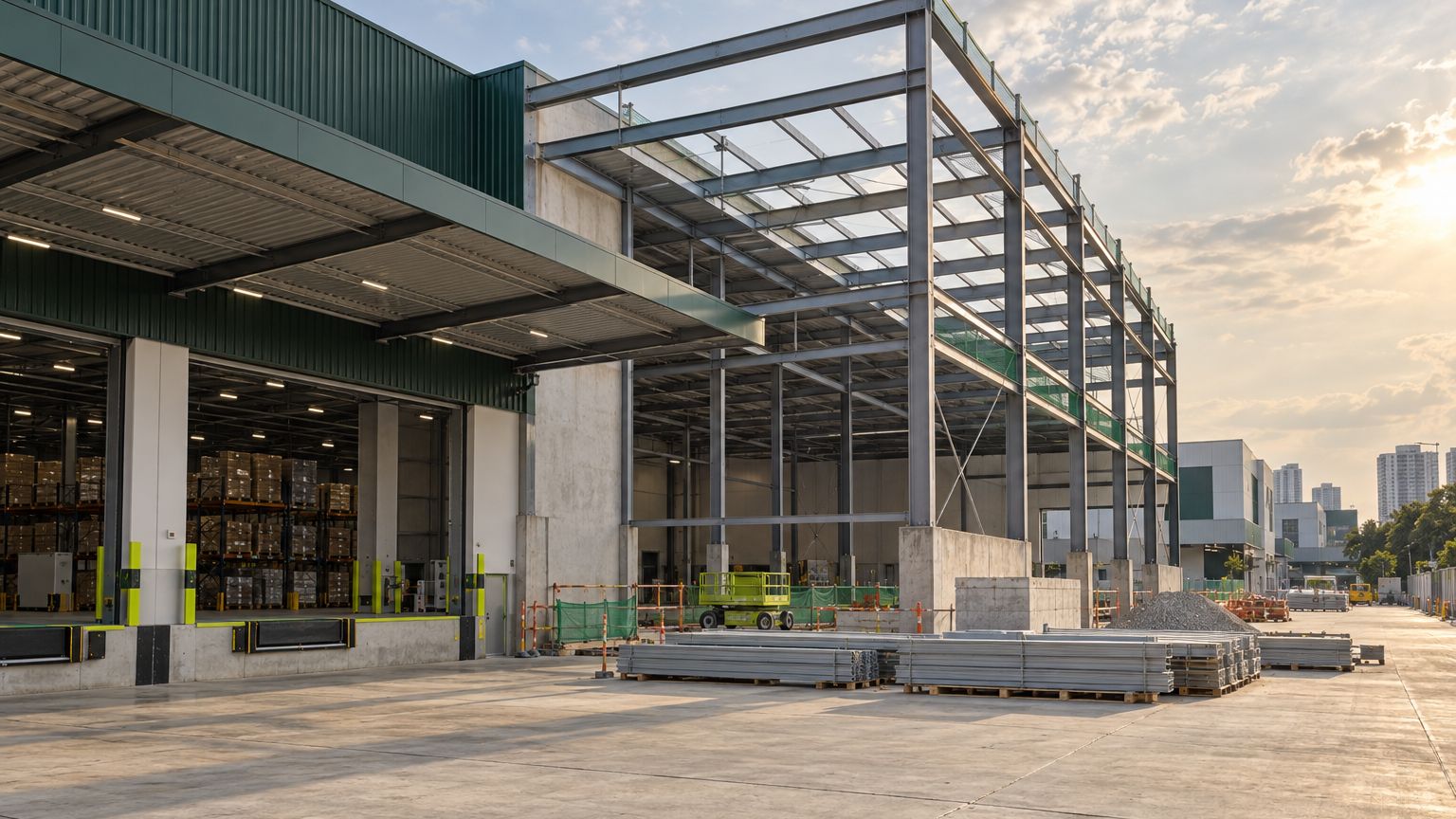
Singapore warehouse and logistics construction costs are forecast to reach US$1,366–US$1,756 per square metre in 2027, against US$1,324–US$1,702 in 2026, according to JLL estimates reported on 11 November. Both ends of that range rise by roughly 3.2%—a higher starting point for owners weighing a new facility.
For industrial owners and occupiers considering ground-up development, the practical issue is whether a proposed building still works at that higher cost. JLL’s advice is to test feasibility against current project-cost information and revisit it as design and procurement decisions are made, rather than rely on an early estimate throughout the process.
A slower increase still means a higher bill
The warehouse figures sit within a broader outlook of continuing, but slightly slower, construction inflation. JLL forecasts Singapore tender prices—the prices contractors submit to carry out construction work—to rise 2.3%–3.3% in 2027, compared with an estimated 2.5%–3.5% in 2026. The reported backdrop is a 30.2% increase in construction costs since 2021.
The distinction matters: easing inflation means costs are climbing less quickly, not returning to their earlier level. An owner using an older feasibility study therefore has two questions to answer: how much the cost baseline has already moved, and what further increase to allow for before committing. That is the practical reading of JLL’s outlook and its recommendation to refresh feasibility with live costs.
The warehouse range makes the next annual step tangible. The lower endpoint increases by US$42 per square metre and the upper endpoint by US$54. Dividing those increases by their respective 2026 endpoints gives approximately 3.2% in each case. These are calculations from JLL’s reported estimates, not changes measured from completed individual projects.
Keep the currency attached, too: these figures are in US dollars per square metre, not Singapore dollars. They provide a construction-cost reference for warehouse and logistics assets; they should not be treated as a quotation for a particular development. JLL’s call for project-specific testing is important precisely because a broad range cannot settle an owner’s actual budget.
Materials, labour and land keep pressure on costs
JLL identifies Singapore’s near-total reliance on imported construction materials as a source of exposure to global price changes. Shweta Choudhari, its Asia-Pacific director of work dynamics research, linked tender-price pressure to energy volatility, transport disruption and base-material costs. She also said contractors were increasingly allowing for geopolitical uncertainty as an enduring risk premium.
The reported materials figures show why a single inflation allowance needs scrutiny. Singapore’s base-material costs rose 7.43% in the first half of 2026 against the 2025 average. JLL expected the increase to moderate to 1.1% in the second half, while separately forecasting a 10.34% rebound in steel prices after a 1.45% first-half decline. An easing overall outlook can therefore coexist with renewed pressure on a particular material.
Labour adds another layer. JLL reported a 2.93% rise in Singapore labour costs in the first half of 2026 and forecast a further 2.58% increase in the second half. It also identified skilled-worker shortages and competition from specialised facilities, including data centres and advanced manufacturing plants, as contributing pressures.
For industrial and logistics development specifically, JLL also points to Singapore’s land constraints as a source of higher construction costs. The relevant takeaway is not to import another market’s warehouse benchmark unchanged: Singapore’s reported range already reflects a more expensive local building environment.
Test the building’s systems, not just its floor area
A warehouse benchmark is a useful opening reference, but JLL flags a material limitation for projects with extensive mechanical, electrical and plumbing systems, often shortened to MEP. Its warning is that headline tender-price estimates may not fully capture that scope; data centres are its example of facilities facing above-average cost pressure.
For an owner, the useful follow-up is to ask the cost team to make those systems visible in the project estimate. Which requirements are already priced, which remain provisional, and how would the budget change if the design changes? This is an application of JLL’s warning, rather than a claim that every warehouse needs data-centre-level provision.
The same approach applies to material exposure: ask what current supplier and contractor pricing supports the allowance. The point is to connect the estimate to the building actually proposed, rather than apply the headline 3.2% increase to every component indiscriminately. JLL’s differing materials forecasts explain why that distinction is useful.
Revisit the commitment before each major decision
Daniel Malacchini, JLL’s Asia-Pacific head of cost advisory and cost management, recommends reassessing feasibility at each design and procurement gate. In plain language, that means checking the numbers again before approving the next design stage or committing to major purchases and construction packages.
A practical interpretation is to ask what has changed since the previous estimate: the scope, the quoted prices or the assumptions still awaiting confirmation. This turns the cost plan into a record of decisions, rather than a single number carried forward after the underlying design has moved on. It follows JLL’s recommendation to use live cost information throughout the process.
Malacchini also recommends considering retrofit and repositioning where they can outperform ground-up development on cost, speed and carbon. That is a comparison to commission, not a promised saving. For an owner deciding whether to build, the next meaningful number is a current cost plan for the required facility—and, where relevant, a properly scoped alternative using an existing building.