153 Kampong Ampat industrial building fetches 16% above guide
LWH Holdings bought the freehold property after a tender drawing more than a dozen bids. Knight Frank reported interest in occupation, redevelopment and conditional dormitory use.
Published 2026-11-07 · 5 min read
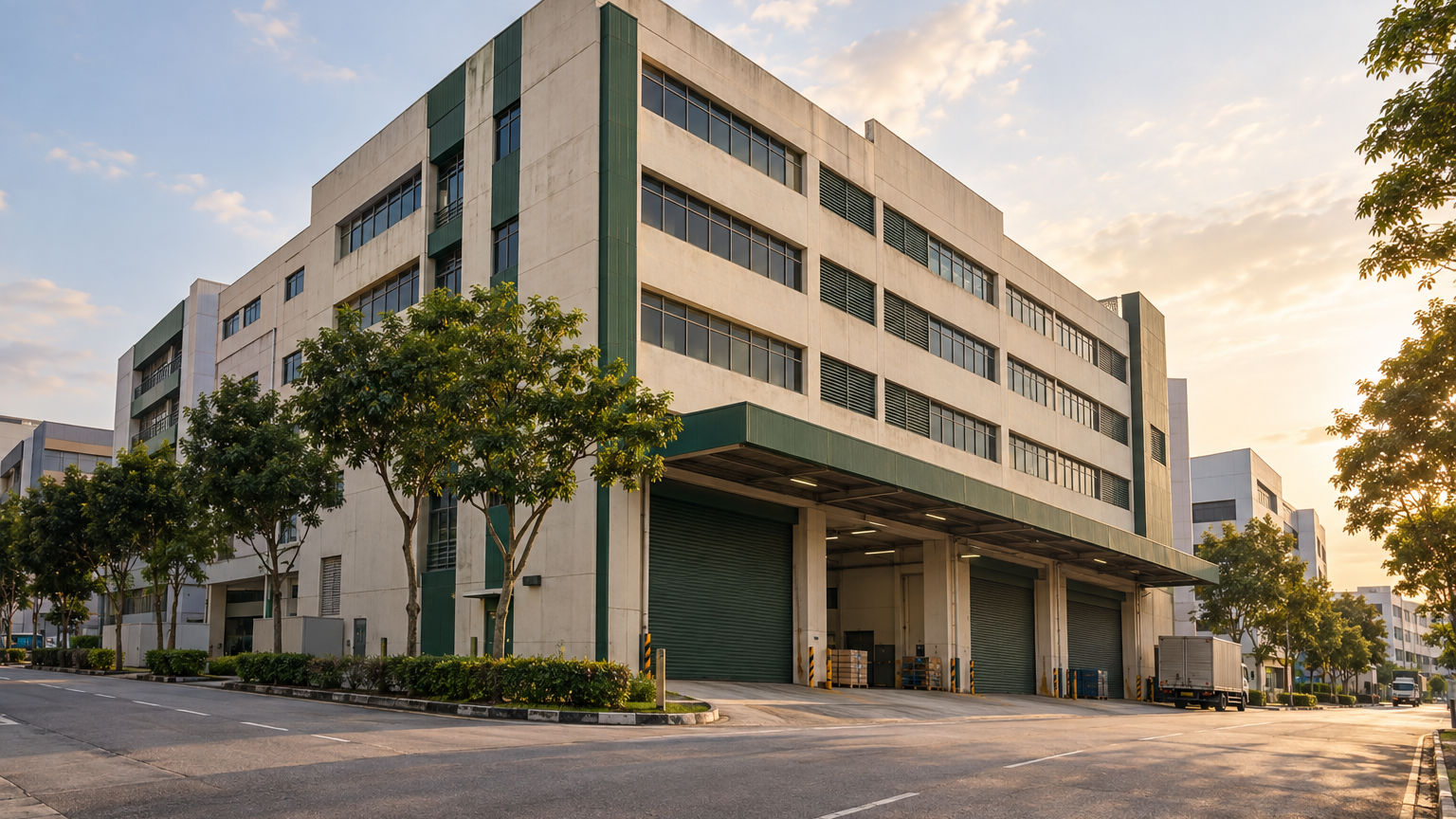
The freehold industrial building at 153 Kampong Ampat has sold en bloc for S$121.8 million, beating its S$105 million guide by S$16.8 million. Exclusive marketing agent Knight Frank Singapore announced the sale on November 5, 2026, identifying construction group LWH Holdings as the buyer.
The tender drew more than a dozen bids, according to Knight Frank, with interest spanning industrial occupation, redevelopment and potential workers’ dormitory use. For owners and buyers assessing sizeable industrial properties, that mix is the interesting part: several different uses attracted attention to the same asset, but the dormitory possibility remained subject to detailed submissions and approvals.
What the S$121.8 million price measures
The seven-storey, multi-user building sits in the Tai Seng–MacPherson industrial precinct. It was launched for collective sale in late September, with the public tender closing on October 23—before the sale announcement in early November.
The reported price works out to approximately S$1,059 per sq ft on the existing gross floor area of 114,969 sq ft. Gross floor area, or GFA, is the building-area denominator used for this quoted price; it is not the site’s land area. The reported land area is approximately 43,354 sq ft.
The guide-to-sale comparison is straightforward: S$121.8 million minus S$105 million gives a S$16.8 million difference. Dividing that difference by the S$105 million guide produces the reported 16% premium. This measures how far the sale price exceeded the initial guide, rather than a change in the building’s value over time.
For a buyer comparing this transaction with another property, keeping that denominator attached matters. The S$1,059 psf figure describes the acquisition price against the existing building’s GFA, not a price for a future redevelopment scheme or approved dormitory capacity. That is the useful starting point for comparison.
Why different buyers were interested
Knight Frank described a varied bidding field. Industrial developers were exploring strata redevelopment, while owner-occupiers were looking for a sizeable freehold property for their own operations. Other investors were evaluating potential workers’ dormitory use.
Those are different reasons to bid. An occupier’s interest centres on housing its operations; a developer exploring strata redevelopment is considering a different future configuration. The agent’s account therefore offers a more concrete explanation of the tender response than simply calling the property popular: it attracted buyers considering distinct ways of using the asset.
The property also combines scale with a corner position, extensive road frontage and visibility. The site is reported as zoned Business 1, with a plot ratio of 2.5 under the URA Master Plan 2025. These are reported site characteristics, rather than confirmation here of any particular redevelopment proposal.
Knight Frank’s interim head of capital markets, Melvin Chay, attributed the response to confidence in industrial property fundamentals and demand for well-located freehold sites offering scale and redevelopment flexibility. That is the marketing agent’s interpretation of demand. The reported bidding mix supports several sources of interest, but does not allocate the S$16.8 million premium among them.
Dormitory interest was conditional
The dormitory angle has a specific qualification. According to Knight Frank’s account, URA had indicated willingness to support secondary workers’ dormitory use at the site. Such use would still require detailed planning submissions and the relevant authorities’ approvals. An indication of support is not an approved operating scheme.
That distinction matters when putting a price on possible future uses. In assessing a similar acquisition, the practical approach is to keep the existing industrial asset separate from a conditional dormitory scenario. A buyer can then see whether its proposed price depends on that scenario succeeding, rather than quietly treating it as part of the property already secured. This is an appraisal distinction drawn from the reported approval condition, not a valuation of this site.
It also keeps the buyer’s identity separate from the bidders’ interests. Knight Frank identified LWH Holdings as the purchaser but did not comment on its intended use. LWH is a Singapore construction, civil engineering, piling and real estate development group operating through its core brand, Lim Wen Heng Construction. The reported dormitory interest concerned investors in the tender pool, not an announced LWH plan.
What owners can take from the result
For an owner considering a sale, 153 Kampong Ampat illustrates the value of explaining an asset’s different possibilities precisely. Knight Frank reported interest from occupiers, developers and investors; each group was considering a different proposition. The useful distinction is between the property being sold and the future schemes bidders were exploring.
The clearest outcome is a reported S$121.8 million sale following a competitive tender. The next substantive question is what LWH Holdings intends to do with the property. Until that is disclosed, the existing-GFA sale price is a concrete benchmark; the potential dormitory use remains a conditional opportunity, not the buyer’s confirmed plan.