Kallang residential redevelopment faces a steeper land charge
Sector 54’s residential rate jumped 29.1%, adding cost to a qualifying uplift without granting Kallang Distripark approval for housing.
Published 2026-10-08 · 5 min read
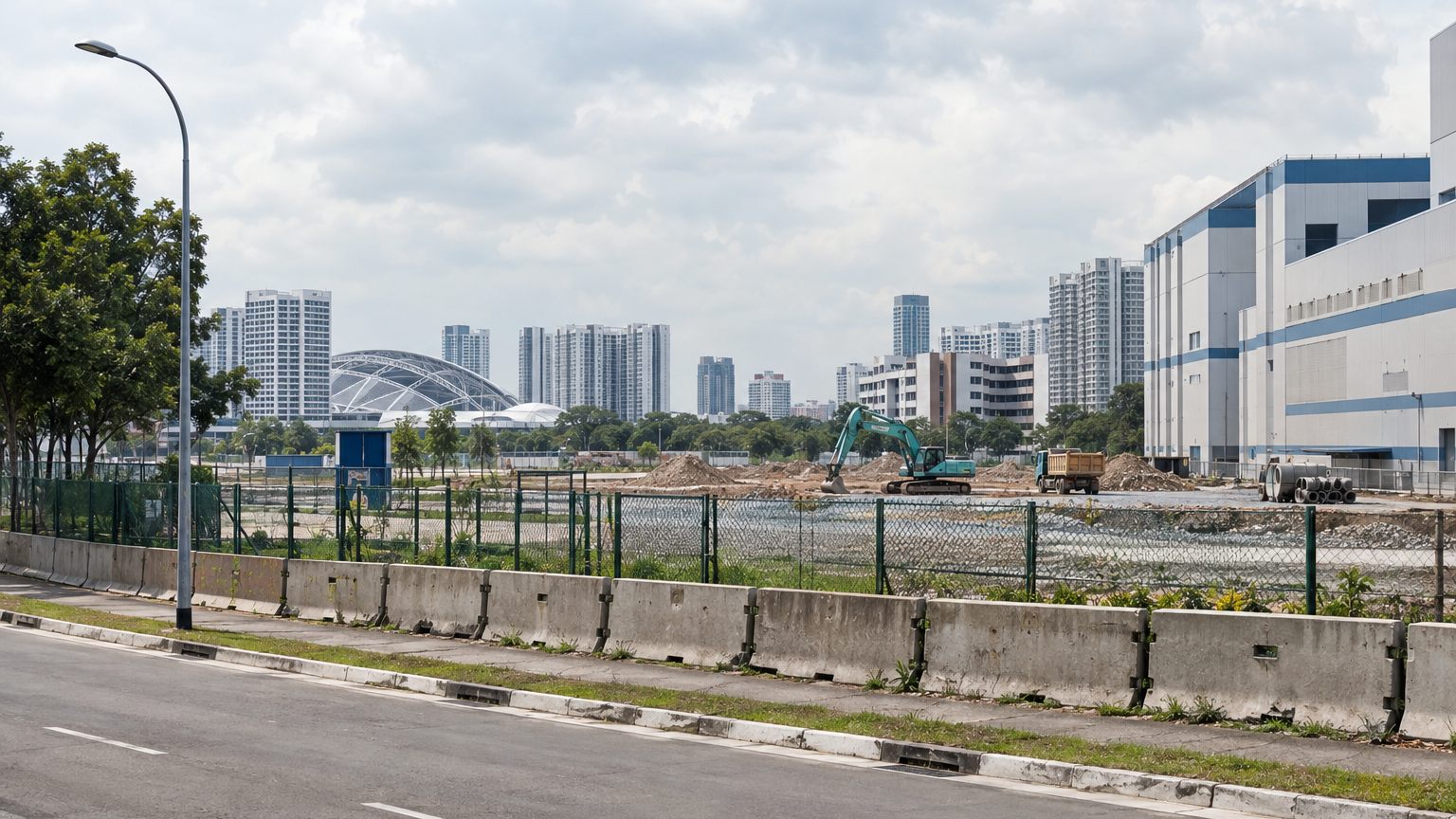
A residential land-charge rate covering part of Kallang rose 29.1% on 1 September 2026, from S$7,700 to S$9,940 per sq m of gross floor area. That was the largest published sector increase for non-landed residential use in the latest rate revision.[S1][S2]
The jump matters if an owner is studying residential redevelopment around Kallang Distripark. It could make the charge for creating additional residential value considerably steeper—but it is not planning permission, an eviction notice or a higher annual bill for every industrial owner and tenant.
A S$2,240 increase per square metre
The Singapore Land Authority’s latest Land Betterment Charge rates apply from 1 September 2026 to 28 February 2027. Nationally, rates for non-landed residential use increased in 70 of 118 geographical sectors, with an average rise of 3.4%.[S1]
Sector 54 moved much more sharply. The calculation is straightforward:
The S$2,240 difference illustrates the potential scale: it equals S$2.24 million for every 1,000 sq m to which the full rate difference hypothetically applied. That is a comparison, not an estimate of the bill for Kallang Distripark or any particular plot.
The industrial rate in Sector 54 rose more modestly, from S$2,058 to S$2,163 per sq m, or about 5.1%.[S1][S2] In the charge tables, non-landed residential use is labelled B2, while industrial, warehousing and related infrastructure fall under D.[S1]
That “B2” label can be confusing for industrial users, who may encounter B1 and B2 in conversations about industrial planning. Here, B2 is simply the residential category in the Land Betterment Charge table; it is not evidence that an industrial building has approval for housing.
The charge applies when approval creates value
Land Betterment Charge, or LBC, is a tax on an increase in land value arising from a “chargeable consent”, such as planning permission for a more valuable development. It replaced development charge, differential premium and temporary development levy on 1 August 2022.[S3]
In plain English, changing a published rate does not by itself create a tax bill. The charge becomes relevant when the required consent adds value to the land, and the statutory framework determines how that uplift is valued.[S3][S4]
A parcel-level assessment would therefore need more than the S$9,940 figure. The owner would have to establish the exact lot and sector, its planning baseline, the proposed use and floor area, and the consent being sought. The rate table is an input—not a ready-made invoice.
This also explains why the increase should not be applied across an existing industrial property’s full floor area as though it were an immediate charge. Doing so would skip the planning and valuation steps that determine whether there is a chargeable uplift and how much land value has actually been created.
Housing is not automatically approved
A higher residential rate can affect the economics of a qualifying residential proposal, but it does not rezone Kallang Distripark. Before anyone treats housing as a workable outcome, the relevant parcel’s official planning status, approved use and development parameters must be confirmed.
That distinction also applies to nearby market activity. A state residential site at Kallang Close attracted a tender process that closed on 7 April 2026, but the closure notice expressly said it was not itself a tender-award announcement.[S5] A tender milestone nearby cannot establish the permitted use, redevelopment cost or feasibility of a separate privately held industrial plot.
For an owner considering a change of use, the sensible order is:
- Identify the precise parcel and its geographical sector.
- Confirm the approved use, planning parameters and remaining lease.
- Define the proposed use and gross floor area.
- Establish whether the proposal creates chargeable land-value uplift.
- Model LBC alongside demolition, construction, financing and occupier arrangements.
The remaining lease deserves particular attention because redevelopment spending and the useful life of the completed project must be considered together. That is a site-specific commercial calculation; the LBC table cannot answer it.
Industrial operations still come first
For a business occupying industrial space today, the residential rate revision does not answer whether its activity is permitted or whether the premises work operationally. An advertised use should be checked against official approvals rather than treated as permission.
Loading access also needs a physical inspection. A unit can look large on paper yet be unsuitable if delivery vehicles cannot turn, loading bays are shared or congested, or goods lifts cannot handle the required loads. Power capacity, floor loading and ceiling clearance likewise have to be matched to the actual machinery, storage or production process.
Rent is only the opening number. A useful occupation-cost comparison should include service charges, utilities, fitting-out and reinstatement work, goods handling, relocation expenses and downtime. These costs may matter far more to an occupier’s near-term decision than a residential valuation rate that applies only if a qualifying planning uplift is pursued.
The new figure is still significant. If the relevant parcel falls within Sector 54 and later receives consent creating additional non-landed residential value, the applicable table benchmark is now substantially higher than in the previous six-month period.[S1][S2]
For Kallang Distripark, that makes residential redevelopment potentially more expensive to model—not more certain. The next useful evidence is the parcel’s planning and title information, followed by a site-specific charge assessment and a full account of redevelopment and occupation costs.
Sources
- Land Betterment Charge · Singapore Land Authority
- Revision of Land Betterment Charge Rates from 1 September 2026 · Singapore Land Authority
- Revision of Land Betterment Charge rates from 1 March 2026 · Singapore Land Authority
- Land Betterment Charge (Table of Rates and Valuation Method) Regulations 2022 · Singapore Statutes Online
- Tender award for URA sale site at Kallang Close · Urban Redevelopment Authority