Kallang Distripark Housing Plan Advances Without a Public Land Bid
The private warehouse compound could hold thousands of homes, but planning approval, redevelopment costs and occupiers’ timelines remain unsettled.
Published 2026-10-08 · 5 min read
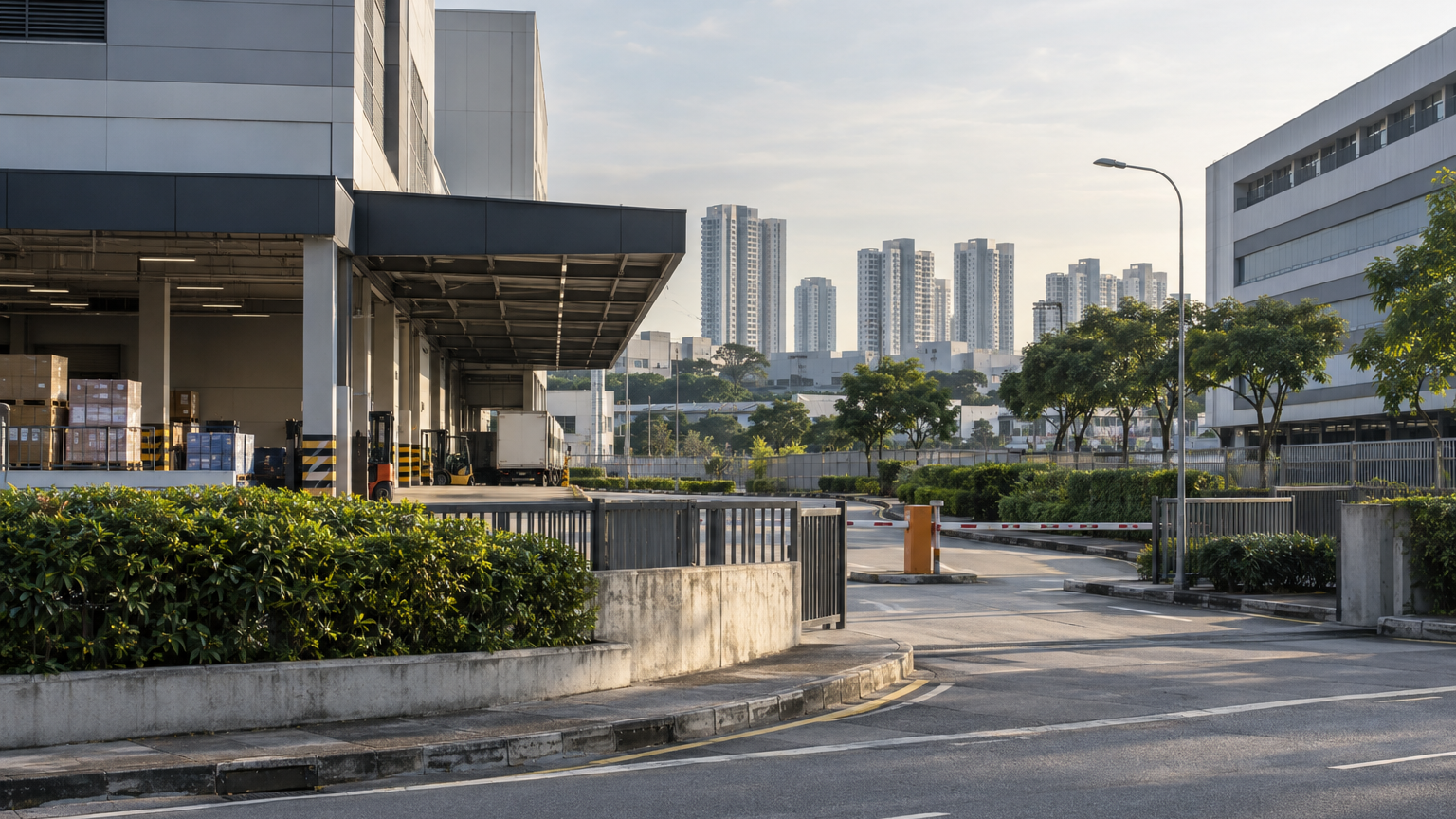
A 13-hectare warehouse compound beside the Kallang River could eventually make way for three private-housing plots, a neighbourhood park and new roads. The plan follows a private development proposal for Kallang Distripark, rather than the public tender normally associated with a Government Land Sales site.[S1]
But this is not yet a 2,000-home project ready for construction or sale. As of 7 October 2026, URA’s register contained no approved amendments to Master Plan 2025, while planning permission is separately required for development works and changes of use unless an exemption applies.[S2][S5]
The housing number is an estimate, not an approval
The proposed layout divides the compound into two residential plots and a third residential plot with commercial space at street level. It also sets aside roughly 2 hectares for a neighbourhood park, together with roads and a reserve site.[S1]
Analysts have estimated that the three housing plots might accommodate about 2,250 to 2,550 homes. URA has not approved that unit count, and the final yield would depend on detailed planning parameters, building design, unit sizes and technical requirements.[S1][S2]
The residential idea itself is not new. URA identified Kallang Distripark in 2017 as a private industrial estate with potential to become a residential precinct with park and recreational spaces. URA’s historical guide also identifies the compound as the former Lee Rubber Factory site.[S8][S9]
What changed in August 2026 was the appearance of a more specific proposed amendment following a private development proposal. That is meaningful progress, but it remains a planning step rather than permission to demolish the warehouses, build condominiums or begin selling units.[S1][S5]
Private land removes the public tender price—not the land cost
Kallang Distripark differs from a typical state housing parcel because its owners do not need to buy the existing land through a new public tender. There is therefore no winning bid that neatly reveals what a developer paid per square foot of permissible floor area.[S1]
That absence should not be mistaken for free land. The owners would still be giving up the property’s existing value and income, while redevelopment could involve tenant relocation, demolition, roads, utilities, financing and construction.
The land is also reportedly split between largely freehold portions and a leasehold portion expiring in 2067. Any valuation or redevelopment arrangement would need to recognise that the parts do not carry the same remaining tenure.[S1]
A planning uplift may also attract Land Betterment Charge, or LBC. This charge applies when a planning decision increases land value; the Singapore Land Authority publishes rates twice yearly, but the actual amount for a development is determined through the formal assessment process rather than by multiplying one headline rate across the whole site.[S3]
For would-be homebuyers, this makes early launch-price calculations particularly fragile. There is no public acquisition bid, no confirmed residential floor area, no approved unit mix and no verified redevelopment bill yet.[S1][S2][S3]
Industrial occupiers still need answers about today’s premises
The residential proposal does not establish when present warehouse operations must cease. Nor does a marketing description such as “warehouse”, “factory” or “storage space” prove the legally approved use of an individual unit.
URA says planning permission is generally required to change the use of premises. Its approved-use enquiry can identify the approved use of a single unit when that information is unavailable through URA SPACE, although the service does not advise whether a proposed new use will be allowed.[S5][S4]
Occupiers should also avoid assuming the compound is automatically governed by familiar Business 1 (B1) or Business 2 (B2) rules merely because industrial activity occurs there. URA describes B1 as accommodating clean and light industry, while general and special industries belong in B2 areas; the available evidence does not confirm that either zoning applies uniformly across Kallang Distripark.[S6]
Before taking or renewing space, an occupier should establish:
- the premises’ approved use and any temporary permission;
- the tenancy expiry, break clauses and relocation obligations;
- the underlying title and remaining land tenure;
- loading-bay size, lorry routes and turning space;
- floor loading, ceiling clearance and goods-lift capacity;
- available electrical supply and the price of an upgrade; and
- service charges, utilities, maintenance and reinstatement costs.
URA’s Legal Requisition service supplies the latest planning decision and current Master Plan zoning for a property. It does not replace engineering checks, title review or a reading of the tenancy agreement, but it can resolve a basic question that advertisements often leave unanswered: what has actually been approved?[S7]
Compare full occupation cost, not rent alone
For an industrial user, a low quoted rent can become expensive when the premises need heavier electrical supply, floor strengthening, new fire-safety works or inefficient manual movement from a distant loading bay. Conversely, a higher-rent unit may cost less to operate if its access and technical capacity already suit the business.
A useful comparison therefore starts with gross rent and adds service charges, utilities, fit-out amortisation, equipment or power upgrades, maintenance and eventual reinstatement. Operational limits—such as restricted loading times or unsuitable vehicle access—should be priced as business costs rather than treated as minor inconveniences.
Kallang Distripark’s proposed residential future makes lease flexibility equally important. Occupiers need evidence of how long they can remain and what happens if redevelopment advances; the proposed amendment alone does not answer either question.[S2][S5]
The next decisive evidence will be an approved planning amendment or a detailed permission showing what can be built. Until then, Kallang Distripark remains an operating industrial compound with a substantial residential proposal—not a confirmed new launch.[S2][S5]
Sources
- Land Betterment Charge · Singapore Land Authority
- Kallang Distripark set to be redeveloped for thousands of new private homes · The Straits Times
- A look at future possibilities for Kallang River · Urban Redevelopment Authority
- Business 2 (Industrial) · Urban Redevelopment Authority
- Enquiry on Approved Use of Premises · Urban Redevelopment Authority
- Kallang River heritage guide · Urban Redevelopment Authority
- Legal Requisition · Urban Redevelopment Authority
- List of Gazetted Approved Amendments to Master Plan 2025 · Urban Redevelopment Authority
- Planning Permission · Urban Redevelopment Authority